
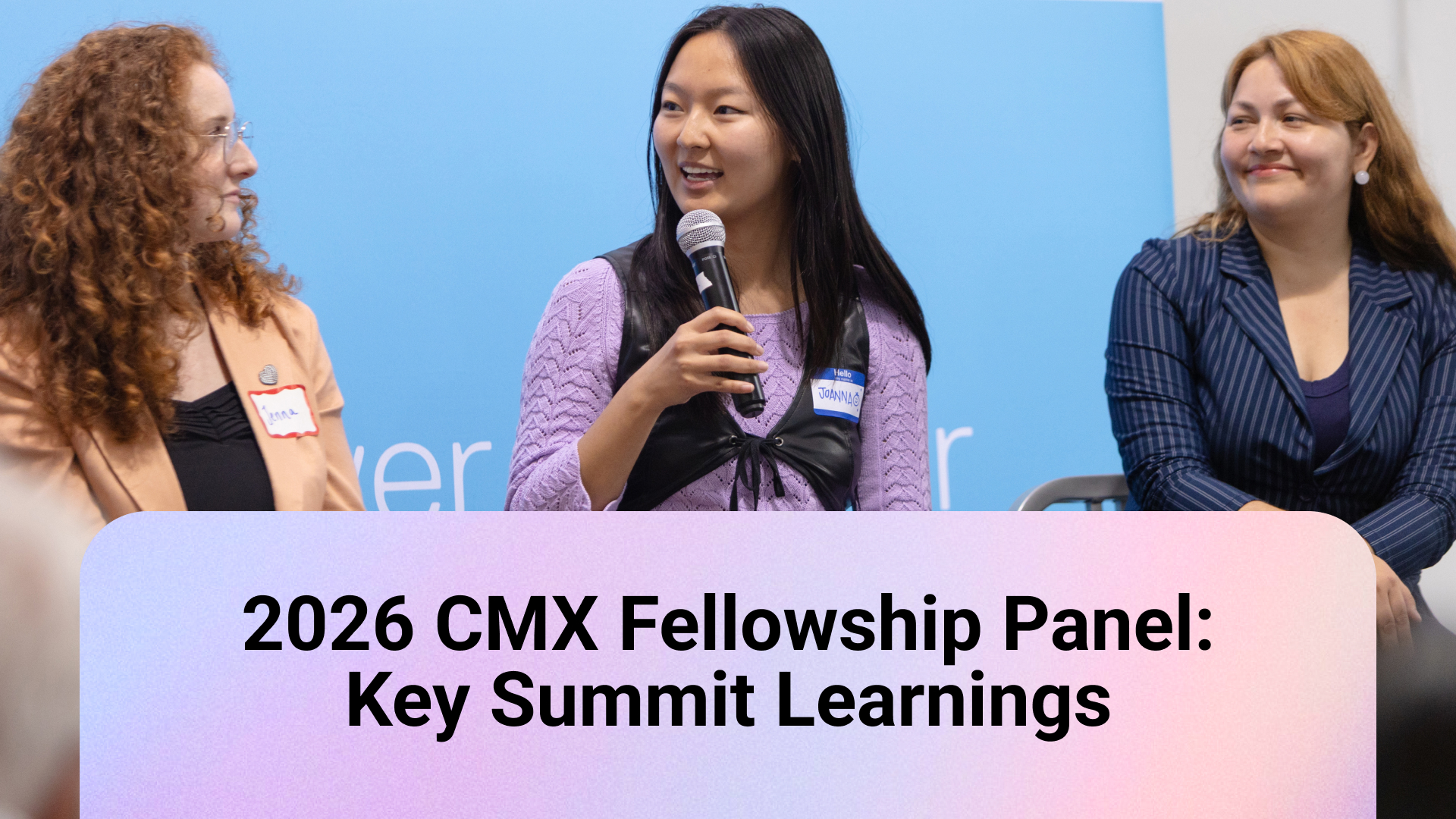
If someone had told me back in 2024, when I walked into the CMX Summit for the very first time, that I would be building a full-time career in the community and events management field, I wouldn't have believed them. After spending almost 10 years in the field of visual design and art direction, pivoting into community and events felt like a massive leap into the unknown. I wanted a career like that, but I didn't even know a path like this existed back then since my world was completely focused on design. To see myself just two years later sitting on a stage as a 2026 CMX Fellow, speaking on a panel alongside Jenna Feldman from Adobe and Joanna Chen from Figma—my brilliant fellowship cohort members—really shows me how much I’ve grown in this career.
The room at the TechSoup office in San Francisco was a wonderful reunion for our local Community Managers Connect event, sponsored by Higher Logic and moderated by their Chief Community Officer, Marius Ciortea. Before our panel even took the stage, Susan Tenby opened the evening by highlighting TechSoup’s global mission to bridge nonprofits with affordable technology, hardware, and consulting to power their daily operations.
As the panel started, everyone in the audience was trying to figure out the exact same things we were talking about at the main CMX Summit, which was how to survive the massive wave of AI pressure while keeping human relationships at the very center of our strategy. We talked openly about our real perspectives coming out of the CMX Summit, the messy realities of scaling engagement, and how to stop treating community like an isolated island.
The AI Shift and the Rise of the Anti-To-Do List
Once we got into the panel topics, the conversation immediately shifted to how we are adapting to the fast-moving AI tools in our day-to-day work. It is all about figuring out the balance of modern execution so we do not automate away the core experiences that make a community feel real.
Our panel group perspective was grounded, seeing human creativity and personal brand as the best way to stand out against AI sameness. One of the most freeing frameworks we discussed was the idea of an "anti-to-do list," which is all about using technology to delegate repetitive, back-of-house tasks so you can protect your time for high-value human work. Approaching prompting as a repeatable skill helps streamline your daily workflow, clearing your schedule for deeper, strategic community building.
For me, the anchor of the whole conference was career resilience, and it came to life during Gilda Hilaire's powerful session on rejection at the CMX Summit. Her talk hit close to home as she shared her journey of facing multiple professional rejections before finally breaking through and creating her own role by consistently showing up and sharing her unique perspective. Facing a sudden layoff at the end of 2023, my own career pivot from design was born directly out of that exact same heavy feeling of rejection. Her perspective beautifully reminded me that when the job market shifts beneath your feet, our real leverage isn't a static job title; it's our ability to adapt and show our proof of concept. Making that transition meant I had to constantly expand my comfort zone, experiment with new tools, hear fresh perspectives, and try new things all the time just to stay employable, adaptable, and true to my curiosity.
Drawing Hard Lines on Authenticity
We also talked about where we have to draw boundaries with these tools. There is a lot of shared skepticism in our group about using automated text to write interpersonal messages or Slack replies to community members.Real connection lives in the unpolished details—the lowercase style, the hyper-specific memes, the slight typos, and the playful language that signal a real human touch. If we automate that, you lose the trust that forms the bedrock of a community.
This need for a genuine human presence is why it is so challenging to scale advocacy programs today. Many large-scale programs are seeing massive waves of applications where candidates use AI to entirely auto-generate their admissions essays. It raises a huge red flag because the entire spirit of an advocate community depends entirely on authentic human voices, not generated copy. Listening to my fellow panelists talk about navigating this inside the massive global programs they run made me realize that while some teams are successfully using internal AI screening tools behind the scenes to manage the overwhelming manual workload, their ultimate goal is protective. They are using technology to filter out the noise so the community doesn't accidentally lose the strong, genuine human voices underneath.
Small, Intentional Spaces Over Hollow Volume
As a panel, our takeaway on event design is that our field is moving toward spaces that value deep relationship tracking over superficial metrics. Raw attendance numbers are an indicator of acquisition marketing, but the true health of an advocacy space shows up in retention and repeat attendance.
A major takeaway from the CMX Summit was the importance of creating experiences centered on how people feel, rather than operational logistics they will eventually forget. Many teams are translating this by moving away from standard, rigid event scripts and focusing instead on how to facilitate meaningful, highly personal local gatherings. Whether it’s an intimate dinner of a few people or an interactive celebration for a hundred advocates, the goal is depth. Technology cannot build an in-person, shared memory. Knowing your members’ milestones, birthdays, and real-life struggles is the ultimate differentiator because, at the end of the day, we are in the business of building genuine, lasting human relationships.
In my current role, I am building our community strategy from the very beginning. Our go-to-market plan relies entirely on fully in-person, small, and curated events because we want to build a deep foundation of organizational trust first. Intimate formats give you the psychological safety to have real conversations. From a broader tech landscape perspective, many companies scale this exact high-touch feeling through dedicated, multi-day forums where advocates get hours of direct access to product engineers and executive leadership, creating a network built on direct communication and genuine support. This aligns closely with how I treat our on-the-ground internal partners, like sales teams, as crucial allies who understand the local regional landscapes as we map out upcoming travel and community touchpoints across different markets.
Bringing Community into the Core Business
We also talked about the reality that community cannot operate like an isolated island. As a former designer who used to look at business metrics from the outside, it made complete sense to me that we only win when we learn to speak the specific language of our internal stakeholders. Just like I used to tie design choices to brand goals, I now look at community data through the lens of what a company needs to grow.
Through my work with startups, I've learned this means moving past unstructured user feedback and using organized channels to deliver clean customer insights straight to product engineers. For customer success partners, it means bypassing abstract engagement metrics altogether and linking event strategies directly to their user retention goals. At the end of the day, proving community value isn't about attendance numbers—it's about proving cross-department alignment.
Shifting Focus to the Work Ahead
Nobody has all the answers right now, and that is exactly what makes this changing landscape so exciting. Marius Ciortea closed our panel with a beautiful observation. He pointed out that while our group demonstrated sharp technical fluency when discussing AI review agents, data pipelines, and analytics metrics, our true passion and energy only broke through when we started talking about human relationships.
That is the absolute heart of what we learned from the CMX Summit. We are navigating a career path where our growth relies on continuously updating our skills and perspectives. While we don’t always know exactly what's next, going through these changes alongside a cohort of peers who truly understand the role helps us figure out where our industry is heading together. Technical curiosity will get you into the room, but your passion for keeping things human is what makes you entirely irreplaceable.
Photo Credits:
LinkedIn: @shengfengchien
Instagram: @shengfeng_chien
Email: shengfengphoto@gmail.com
Portfolio: https://shengfeng.webflow.io/


.svg)


.svg)

